
Here’s the third in my series on citizen-led action, focusing on the coalition government’s scrapping of women’s pay equity claims. Transcript below video. My editing skills still a work in progress!
This is the third in my series on how peaceful collective citizen-led action has and will continue to be the way rights are gained and people are protected – and why your vote, carefully considered, is so important.
I’m calling this one: Rights build on rights, build on rights — until the bastards take them away
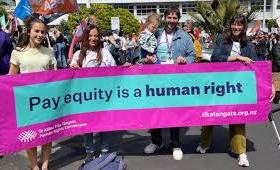
You’d think in 2026, we’d all be in agreement that women deserved to paid the same as men in similar positions. Aotearoa was first country to give women the vote, yet here we are with a government who not only don’t give a damn but actively changed the law to work against this – all to pay for tax cuts for the country’s richest people. And they not only changed the law, but did it in a devious way, ignoring expert advice and passing a new law under ‘urgency’ – shutting out any discussion and killing dead 33 claims on the spot.
Last week the People’s Select Committee on Women’s Pay Equity – led by 10 former MPs from across the political spectrum – delivered their report after hearing submissions from individuals and groups who were not able to be heard on the Equal Pay Amendment Bill 2025 because of the coalition’s abuse of ‘urgency’ and their utter disrespect for the women of Aotearoa.
These wonderful women – received 1390 substantive submissions and held 3 months of hearings. Finally, they reported back on Tuesday Feb 24th, 2026, describing the processes of planning for and enacting the Equal Pay Amendment 2025 as “a flagrant and significant abuse of power”.
To quote their press release:
The Committee found breaches of:
- the Regulatory Standards Act principles,
- the Legislation Design and Advisory Committee Guidelines,
- the New Zealand Bill of Rights,
- the Human Rights Act,
- ILO Convention 100,
- the International Covenants on Civil and Political, and Economic and Social Rights,
- the Convention on the Elimination of All Forms of Discrimination against Women
- the UN women’s Convention,
- and the Conventions on the Rights of People with Disabilities and the Elimination of All Forms of Racial Discrimination.
The Committee found the retrospective cancellation of existing rights and remedies was a serious violation of the rule of law. Funded sector employers, charitable organisations and unions have already spent millions of dollars and thousands of hours on the 33 cancelled claims.
The Committee found that no evidence was produced in any of the accessible Cabinet documents, in press statements or in the parliamentary debates, to support the demolition of the world’s leading pay equity regime.
The Committee found that no budget savings were made in cutting pay equity – the funds were reallocated to other government expenditure and Coalition Government priorities – i.e. further enriching their donors.
No Minister, or briefing bureaucrat, and no speaker in the parliamentary debate, demonstrated any knowledge of how comparators (i.e. librarians with fisheries officers) and factor scoring work.
The Committee found that it is a sophisticated, highly rigorous process of co-research between worker and employer negotiators. The only evidence of attempts to game the system the Committee could see were in the behaviours of government agencies.
It’s so bloody disheartening to watch women’s rights be so callously and casually wiped away. Rights that thousands and thousands of women over the decades have fought so hard for. While writing Protest! Shaping Aotearoa, one of the themes that came through was that once a right was gained, it opened the door to expand that – in other words, that rights build on rights. Let’s briefly look at that.
Although the first written argument for women’s suffrage in English was clearly voiced by Mary Wollstonecraft in 1792, the first suffrage pamphlet written in Aotearoa was in 1869 by Nelson woman Mary Ann Muller, writing as Femmina’, as her husband didn’t approve.
In her ‘appeal to the men of NZ’ she said, ‘Let the laws be fitted to the people and times. Do you still persecute for religious opinions? Do you still burn for witchcraft? Why, when the broad road of progress is cleared for so many human beings, is the juggernaut car of prejudice still being driven on, crushing the crowds of helpless women beneath its wheels?.’
‘How long,’ she asked, ‘are women to remain a wholly unrepresented body of people?’
At the time, women were ruled as in the same class as ‘children, lunatics and criminals’ – all banned from voting.
Another courageous woman, teacher Mary Colclough, wrote letters to local newspapers under the penname ‘Polly Plum’, giving public lectures in Auckland, Thames, Ngaruwahia and Hamilton with titles such as The Subjection of women’– a remarkable action for a woman of that time.
In response, The Waikato Times thundered that “the majority of women are unfit even to have authority over their children . . . To make them legally equal to their husbands would be disastrous in the extreme . . . Woman’s power is her weakness, her tenderness, and her ability to love deeply . . . May the day be far distant when the agitation in favour of ‘Women’s Rights’ shall destroy the charm of English home life.”
Indeed, one of the loudest opponents of women’s suffrage, Dunedin MP Henry Fish, said,
“When will this outrageous mixing-up of the sexes stop once you begin it? I say that bringing women into contact with politics will destroy that refinement, that delicacy of character, which has been her greatest charm hitherto.” Fish is now remembered for the reputation he gained as ‘conceited, rude and untrustworthy’, esp. when it was discovered he falsified signatures on anti-suffrage petitions.
Māori women, too, spoke out. On 18 May 1893 Meri Te Tai Mangakahia of Te Rarawa spoke these words at Te Ko-tahitanga Parliament in Waipatu in the Hawkes Bay, becoming the first woman recorded to have spoken in any parliament in Aotearoa. In her address Meri asked for much more than the vote – demanding that Māori women also be able to stand as members of Te Kotahitanga.
She said: There have been many male leaders who have petitioned the Queen concerning the many issues that affect us all, however, we have not yet been adequately compensated according to those petitions. Therefore I pray to this gathering that women members be appointed. Perhaps by this course of action we may be satisfied concerning the many issues affecting us and our land.
Perhaps the Queen may listen to the petitions if they are presented by her Māori sisters, since she is a woman as well.”
Despite a wall of resistance, Aotearoa’s women did not give up. They rallied, wrote letters, signed petitions, lobbied parliamentarians, slowly shifting the goal posts. 1875 saw women who owned property given the right to vote in local elections. But their efforts to gain voter rights for general elections were turned down in 1878, 1879 and 18887.
They presented their first petition to Parliament in 1891, signed by more than 9000 supporters – to no effect. Six more petition were signed by over 19,000 women. Again they were ignored. In 1893, the biggest petition yet to be presented had nearly 32,000 signatures from 13 regions. Finally, politicians were forced to listen. But yet again it was nearly scuttled by premier Richard Seddon, who tried to rig the numbers. It was only through the support of the new Governor, Lord Glasglow, and the continued work of the suffragists, that the vote was finally granted on 19th September 1893.
Kate Sheppard, perhaps the most famous of our suffragists, said that day, ‘It does not seem a great thing to be thankful for, that the gentlemen who confirm the laws which render women liable to taxation and penal servitude have declared us to be “persons”… We are glad and proud to think that even in so conservative a body as the Legislative Council there is a majority of men who are guided by the principles of reason and justice, who desire to see their womenkind treated as reasonable beings, and who have triumphed over prejudice, narrow-mindedness and selfishness.’
This wasn’t the end, however. Now voting rights had been granted, women stepped up to build on these rights – rights women today take for granted. These included: being allowed to stand for Parliament, the right to divorce, access to birth control and safe maternity care, welfare support for solo mothers, laws against sexual and domestic violence, abortion rights, moves towards equal pay, parental leave, the right to walk the streets in safety, so-called ‘slut-walk’ rallies to stop victim blaming and underline consent – i.e. ‘yes means yes and no means no’, and more recently, the ‘Me too’ movement.
I can’t overstate how many women have had to fight for these basic rights – to have their body sovereignty protected and to share in the human rights already granted to men. Each step was fight, women putting themselves on the line for their ‘sisters.’
This is why the current coalition government’s disgraceful wiping of women’s pay parity is so shameful. It’s a slap in the face to every woman who’s fought tooth and claw for fairness and the right to live their lives their own way.
Every woman and man who believes in universal human rights should reject these grifters. Let’s vote them out.









 Mandy Hager