
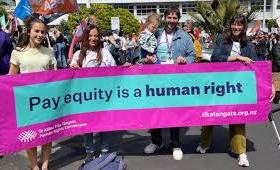
Kia ora! Here’s the second in my series on how citizen-led protest has led to the rights we take for granted today. Meanwhile, the current coalition government is doing all they can to undermine them, driving us backwards.
Let’s vote this lot out!
Transcript:
Last week saw a slew of changes to employment law from this current coalition government, including what the PSA claim is a “fire at will” clause for those earning over $200,000.
They’ve also scrapped the 30 day rule that automatically gave new employees the same conditions as the collective contract, whether they’re in a union or not, seen by the CTU as a direct attack on union membership.
They also added a clause with provisions to allow employers to deduct 10% of pay during partial strikes – another government attack on unions and workers, rather than trying to fix the underlying work issues that drive such strikes.
The new contractor “gateway test” has also been dubbed the Uber Law, included after vigorous lobbying by Uber, who were keen to overrule the Supreme Court decision stating that drivers should be considered employees not contractors. This new law lets employers off the hook for sick and bereavement leave, and annual holidays – affecting people in many sectors, including the film industry, construction, transport, cleaning, security and labour hire – another back-pat to bosses as workers rights are degraded.
While the government (and the vampiric Ms Van Veldon) claim they support workers, they are once again doing everything they can to undermine workers rights to enrich those at the top. They’ve also undone health and safety requirements, proven to save lives.
Rights such as these have been hard fought for over decades and decades, incrementally inching forwards, rights building on other rights, workers bravely standing up for themselves while the bosses and government fought back, sometimes brutally.
All the protections for workers that currently exist have come to pass by ordinary people trying to make a difference – not only for themselves, but for their colleagues and those who come after. Brave people, who, through speaking out and collective action, put themselves in the firing line for the betterment of all, attacked by governments supposedly elected to protect them.
Let’s not forget the Māori timber workers who walked off the job in 1821, wanting to be paid in money and gunpowder rather than food.
Or Wellington carpenter Samual Parnell who, in 1840, rallied men from all over the country to refuse working longer than an eight hour day. When offered work to build a store for shipping agent George Hunter, he declared:
“I will do my best, but I must make this condition, Mr. Hunter, that on the job the hours shall only be eight for the day … There are twenty-four hours per day given us; eight of these should be for work, eight for sleep, and the remaining eight for recreation and in which for men to do what little things they want for themselves. I am ready to start to-morrow morning at eight o’clock, but it must be on these terms or none at all.”
Today, we honour his and his supporters brave stand on Labour Day.
While Parnell and the plucky miners associated with the 1908 Blackball miner’s strike succeeded in peacefully settling for shorter days and longer lunch breaks, others were not so lucky.
The Waihī strike of 1912 grew violent when William Massey’s anti-union government took power. Hundreds of non-union strike breakers were driven to the mines in horse-drawn wagons, guarded by police. And when tension boiled over on the 12th November, strike breakers attacked the union hall, and Fred Evans, one of the strikers, was beaten to death, before the strike-breakers stormed around Waihī, smashing property, hurting anyone in their path. The strikers and their families were forced to run for their lives.
This government sanctioned anti-union violence reached appalling heights in the 1913 ‘war on the wharves’. By November 1913, around 16,000 workers across the country were striking for greater control of their workplaces. To break the strike, the government ordered police to call for volunteers and thousands of rural labourers and farmers turned up to assist government troops, many on horseback, given the power to act as ‘special constables’, armed with wooden batons, guns and horsewhips, dubbed ‘Massey’s Cossack’s’ by the strikers.
This triggered brutal fighting in the streets that lasted weeks, storekeepers told not to serve strikers, two naval ships sent to guard the wharves with bands of uniformed men parading with their bayonets and a machine gun. Eventually the government arrested the main strike leaders and the strike fizzled out, as people needed to feed their families.
The 1951 Waterfront dispute was the biggest strike in the country’s history, lasting 151 days, with nearly 22,000 waterside workers walking off the job at its peak, demanding better rights and improved safety measures. Their work was hard, heavy, dirty and dangerous, with 1300 injuries on the Auckland wharves in 1938 alone. There was virtually no safety equipment, little job training, and inadequate first aid, alongside dangerously long hours.
The government declared a state of emergency and PM Sidney Holland warned the country was ‘at war’. Five days later troops appeared at Auckland and Wellington’s wharves, police sent to arrest the ‘wreckers’. It was made a crime to help the strikers – even giving food to children was banned – hoping to starve them into submission. But the strikers and their supporters fought back with the help of their community, writing illegal newsletters, setting up radio broadcasts, but as winter set in, bullying and violent outbursts against the strikers grew.
At the end of April, a railway bridge near Huntley was blown up and the strikers were blamed – though the train drivers had been warned and no one was hurt, coal supply was disrupted. Sydney Holland declared it ‘an infamous act of terrorism’ and from that point, any man caught at a street protest was attacked by baton-swinging police. The 1st of July was so violent it became known as ‘Bloody Friday’, with 1000 marchers driven off Queen St in Auckland, leaving more than 20 protesters injured.
When the strikers gave in, many were banned from the wharves for years. And it wasn’t only the men who suffered. Labour MP Mabel Howard called the dispute a ‘war on women’, because the wives of strikers had to survive on no income and it was illegal for anyone to help them. In Wellington’s Clifton Terrace school, striker’s children were separated from other pupils during breaks in case anyone illegally shared their lunches.
These were people trying with all their might to improve their lives, safety and conditions, not criminals, yet these governments, supposedly elected ‘by the people, for the people,’ solely acted on behalf on the bosses. These examples, and more, can be found in my book ‘Protest! Shaping Aotearoa. Sadly, once again we are seeing these anti-worker tactics unfold today.
Hard fought for rights are being stripped away, and those who speak out are being labelled and maligned by this government. We’re moving in the wrong direction. Let’s vote them out.
Ngā mihi, thanks for listening.







 Mandy Hager